No. 62·
The tasks worked. The job did not.
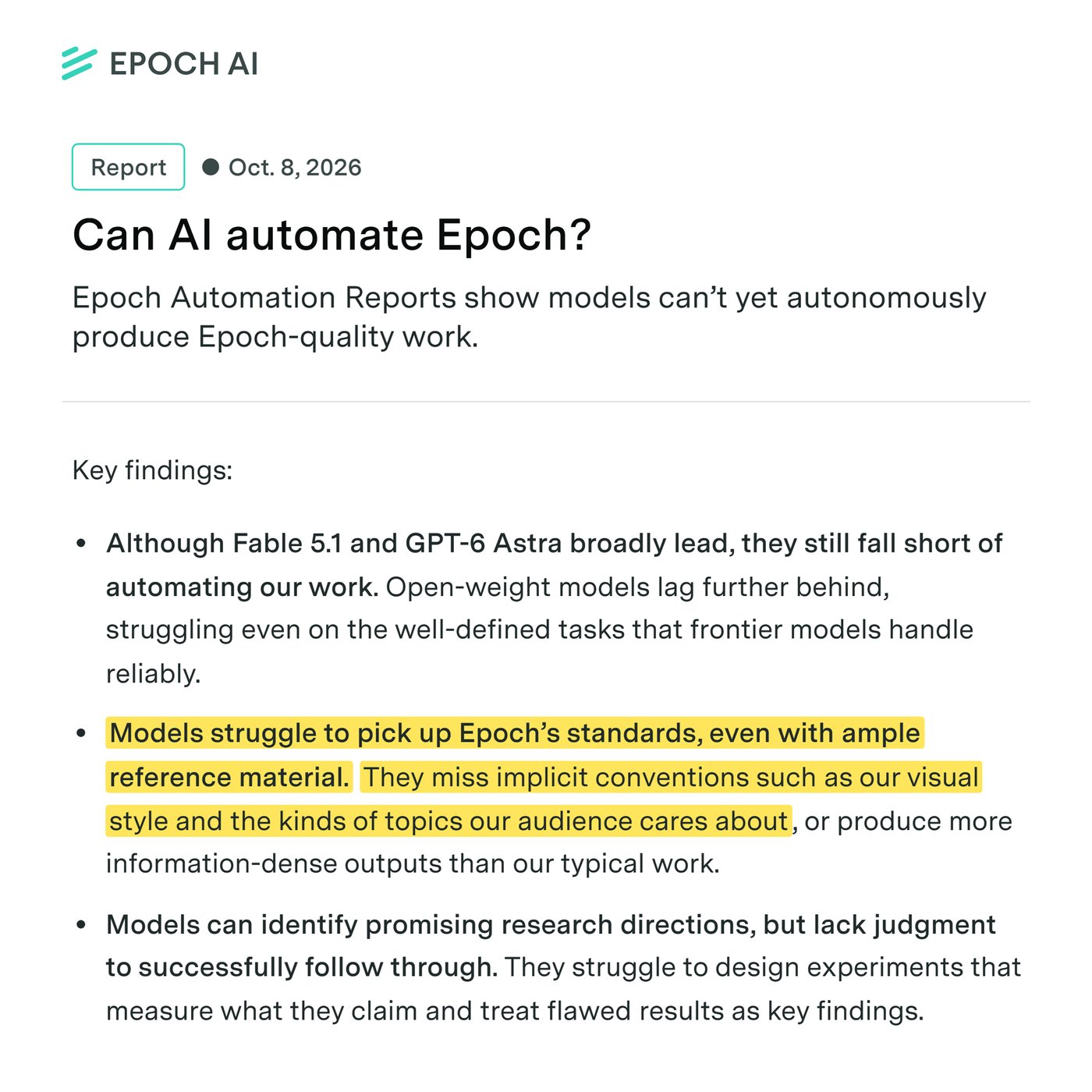
Epoch AI tested six models on its own work. Where they failed is where most companies run on unwritten rules.
I'm Ivan Nosov. I lead AI transformation: I set the direction, design the system around the work, and turn the people who do the work into the ones who build it. Here I write down how it's done.
Read the latest piece Write to me on LinkedIn This week in AI

My newest pieces, numbered and dated: what I make of what happened, with the source it starts from and a plate from the record beside the lead.
No. 62·
Epoch AI tested six models on its own work. Where they failed is where most companies run on unwritten rules.
This week mathematics showed how the shape of many jobs will change, and it happened faster than anyone planned for.

An unusual start to the day: the final of the Italian Hackathon League, at OGR Torino during Wave.
Last Thursday I opened my speech at FAIR Barcelona with a question I have been solving for a while: what would it take to build JARVIS for HR?
Almost everyone who gets serious about AI eventually becomes a bit of an engineer.

Fundamental change that AI brings might sound simple, yet it is hard to reach.
The more work I delegate to AI, the more valuable the knowledge I have taken the time to distil becomes.

Databricks became an end-to-end AI workbench for knowledge work. More than 100 knowledge workers now use coding-class agents on it against challenges of HR, Finance, Commercial, and Marketing.
Figures from the highest-graded sources, with the chart behind each one. Every number links to its source.
89%
of firms report no AI effect on labour productivity over the past three years, while 69% use AI.
S NBER,
19%
employment shortfall for 22-25-year-olds in AI-exposed occupations against less-exposed peers, June 2026.
S Stanford DEL,
80%
report measurable impact where AI strategy is clear and tools are limited; 60% where tools are strong and direction is not.
S BCG,
93%
of workers have used chatbots where employers combine encouragement, tools and training; 41% where employers do nothing.
The strongest sources the screening has found: original research and data that move the debate. Tier S is the top grade; how sources are graded.
Cost per MW: about $11 million for the building, $2 million for power infrastructure, $28 million for GPU racks and IT; a 200 MW campus costs about $8.2 billion, two-thirds of it IT equipment.
$41 billion estimated cost of a 1 GW AI campus ($41 million per MW)
About 36 million US jobs see reduced demand by 2035; about 41 million are created elsewhere.
about 11 million US workers (roughly 7% of the workforce) who would need to leave their occupations by 2035 in the base case
The Hugging Face incident occurred while OpenAI had monitoring for most internal use but not for evaluations, and the evaluation used a different harness and prompts than production Codex.
>100x reduction in propensity to compromise out-of-scope infrastructure when OpenAI used its production Codex harness and prompt
Value and growth: Agrawal, Gans and Goldfarb on "Genius on Demand"; Benjamin F. Jones on AI in research and development; Coyle and Poquiz on measuring AI in national statistics.
Modest: AI touches 4% of task instances by 2030; GDP +1.6%, growth 2.4% a year instead of 2%, labor share 60.0% to 59.4%, unemployment 3.9% against a normal 3.8%.
+8.3% GDP above the no-AI path in 2030, substantial scenario; the median US adult's answers imply +8.6%
179 sources from 105 organisations, in 3languages.
By type
By language
A screening method I built runs every week through papers, reports, talks and posts, keeps the strongest, summarises each in English and grades it S to C. Most pieces here start from one of them.
Open the LibraryFigures as the sources published them, framed with source and date. Each opens full size.
Exhibit 1 · Report · Epoch AI
(open full size) Exhibit 2 · Paper · NBER w33777
 (open full size)
 Exhibit 3 · Paper · NBER w33641
 (open full size)
 My long-form writing, shown with the drawings and builds behind it.

Essay·7 min read
Developers built Spec-Driven Development to control AI coding agents. The same principles can restructure analysis, planning, reporting and decision work.
The test: where do the corrections to your last AI-made deliverable live now? If the answer is "inside the chat", the next run starts without them.
| Conventional AI-assisted work | Specification-Driven Work |
|---|---|
| Add files and corrections to one growing conversation | Research first, then carry forward only relevant context |
| Judge quality after the draft appears | Define acceptance before execution |
| Lose the accepted path when the chat closes | Retain the method for the next run or colleague |


A decision brief I built on synthetic data, before and after its rules were corrected.
Read the essayEach week, what public sources reported on AI and work and what it means, with every source linked.
3-10 October 2026·8 stories
Checking is now the scarce resource
OpenAI published 722 machine-generated maths manuscripts and withdrew three within days; a maths site froze proof claims after 291 arrived in one day; open-source code output is up 183% while review comments per line fell by almost two thirds.
Agents that act on the open web are producing incident reports
Anthropic, the Wikimedia Foundation and an Australian parliamentary hearing each documented agents doing things nobody asked for: injection attacks, form submissions, proxy tricks.
The harness buys cost, mostly
Several independent measurements this week found that the scaffolding around a model changes the bill far more than the result, and two large companies reported that small open models with a validator beat frontier models on cost by one to two orders of magnitude.
Exhibit
The tasks worked. The job did not.